

If an okari nut falls in the forest, you’re definitely going to hear it.
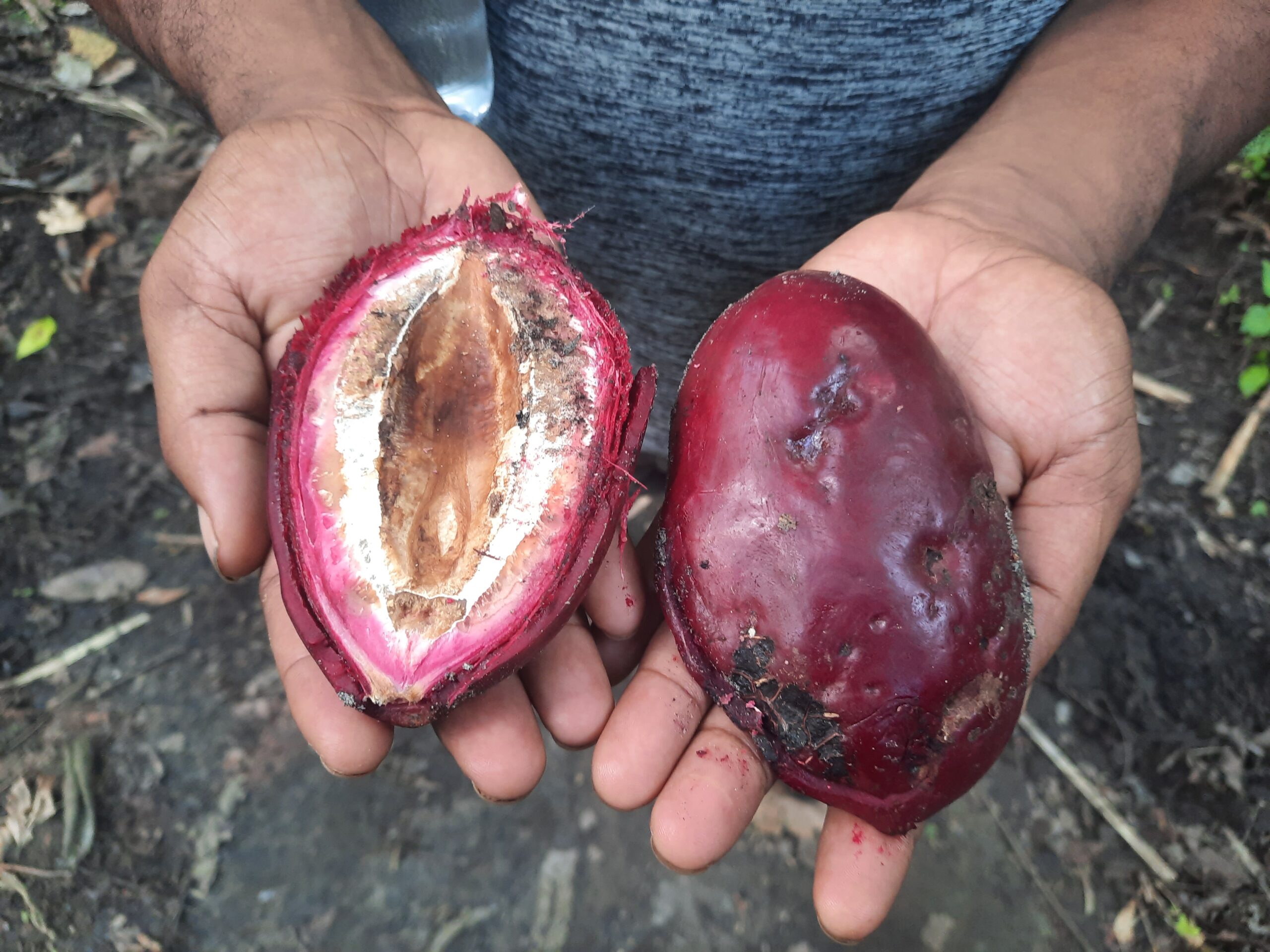
The oval crimson husk — larger than an adult’s palm — drops by the hundreds from the 30-metre canopy of the okari tree (Terminalia kaernbachii) between May and August each year. Native to the lowland rainforests of Papua New Guinea’s Oro Province, the tree was introduced to the Managalas Plateau several hundred years ago and has since become embedded in local diets and livelihoods.
Over generations, communities selected trees for the size and flavour of their nuts, planting them in old gardens and along clan land boundaries. Those abundant, creamy white kernels, similar in taste to almonds, provide a rare and valuable source of protein in a region where such foods can be scarce. The timber is often used for furniture, while the brightly-coloured husks can be boiled to produce dye for tapa, or bark cloth.
“Land tenure [in Managalas] has many variations,” says Will Unsworth, Papua New Guinea(PNG) programme manager at the Center for International Forestry Research and World Agroforestry (CIFOR-ICRAF). “But if you plant an okari tree and keep maintaining it — cutting the grass around it, climbing it, harvesting it — then you can own it and all of the nuts it produces. Your children can inherit the tree too.”
With their diverse uses and cultural value, okari trees have long played a central role in local economies. They are also key to a much larger question that continues to shape the Managalas Plateau: how to secure sustainable livelihoods without sacrificing the forest.
Is the forest worth more dead or alive?
When Mike Olsen, a US-born linguistics lecturer at the University of PNG, began visiting Managalas with groups of undergraduate students in the 1980s, they were struck by both the area’s extraordinary beauty and richness of natural resources and the persistent challenges facing its communities — struggles to secure basic needs like healthcare, education and income.
At the time, logging was intensifying across the country. International companies made (literal) inroads into new areas, pushing deeper into forested regions, and many Indigenous landholders were transferring rights in exchange for cash. The result, in many places, was rapid forest loss and social disruption. Managalas, Olsen and his colleagues realized, was vulnerable to the same trajectory.
The abundance of okari trees in the area offered a possible alternative. The size, quantity and quality of the nutssuggested the basis for a Plateau-based enterprise that could generate income while keeping the forest standing. Olsen’s group — later known as PNG Trust and then Partners with Melanesians — began exploring whether okari could form the basis of a sustainable Plateau-based eco-enterprise. They also started running environmental education programmes to help locals understand the value of their natural resources (including okari trees) and the long-term implications of unsustainable development decisions.
Mist drifts over the forested slopes of the Managalas Plateau in Papua New Guinea’s Oro Province, where communities are exploring ways to earn income while keeping the forest standing.
Photo by CIFOR-ICRAF.
Early ambitions were global. The group initially hoped to market the nuts to international confectionery companies as a substitute for almonds in nougat-based products. But a 1993 scoping study clarified that this wouldn’t be viable: the nuts are seasonal, while large manufacturers require a stable and consistent year-round supply.
More modest success followed closer to home. Nuts were transported to Port Moresby, first by steamship and later by air. But logistical fragility soon became apparent.
In 1996, the threat of industrial logging sharpened. The national government earmarked two large tracts of Plateau rainforest for forestry concessions. But then, awareness of the value of okari trees — and the forests that supported them — had grown. Most local landholders opposed the proposition. With support from advocacy organizations, they succeeded in having the concessions withdrawn.
That decision drew international attention. The Rainforest Foundation of Norway (RFN) later supported a lengthy process that culminated, in 2017, in the declaration of the Managalas Conservation Area (MCA), covering 214,696 hectares. Yet the okari enterprise that helped catalyse this outcome never fully stabilized and got off the ground. Prices and demand in Moresby fluctuated, and the freight process proved unreliable, with villagers frequently hauling heavy sacks of nuts at great effort to remote pick-up points, only to be told that their charter had been cancelled — and might not return until the nuts had gone off.
“This situation creates unease and sorrow,” Caplin Sano, an Anglican Church evangelist and community facilitator from Suari Village, told external evaluator Nancy Sullivan in 2010. “We used to break the okari and throw them away, empty our bags, cry and go back home.”
“Only strong, able-bodied people take those bags all the way to Afore Station, catch [a truck] there and continue to Popondetta, sell them and buy soap and salt and return.” When the cost of charter flights increased in the early 2000s after the government stopped subsidising them, the people of Managalas stopped trying to sell okari outside the Plateau.
A windfall worth preserving
Eight years after the declaration of the MCA, okari nuts are once again on the agenda as a potential livelihood source. This time, the project team is exploring how to commercialize the nut into a finished product that can be made in Managalas and sold domestically — and potentially overseas, too.
The renewed effort builds on lessons learned elsewhere, benefiting from the work of other trailblazers. In nearby Kokoda, researchers at Australia’s Griffith University are already experimenting with developing okari value chains, with funding from the Australian Centre for International Agricultural Research (ACIAR). Their work draws heavily on experience with another indigenous nut.
For more than a decade, Associate Professor Shahla Hosseini-Bai, academic lead of environmental sustainability and management at Griffith University, has worked with communities in PNG’s New Ireland Province to develop standards, processing procedures and marketing strategies for commercialization of galip nuts, which grow on the native galip tree (Canarium indicum).
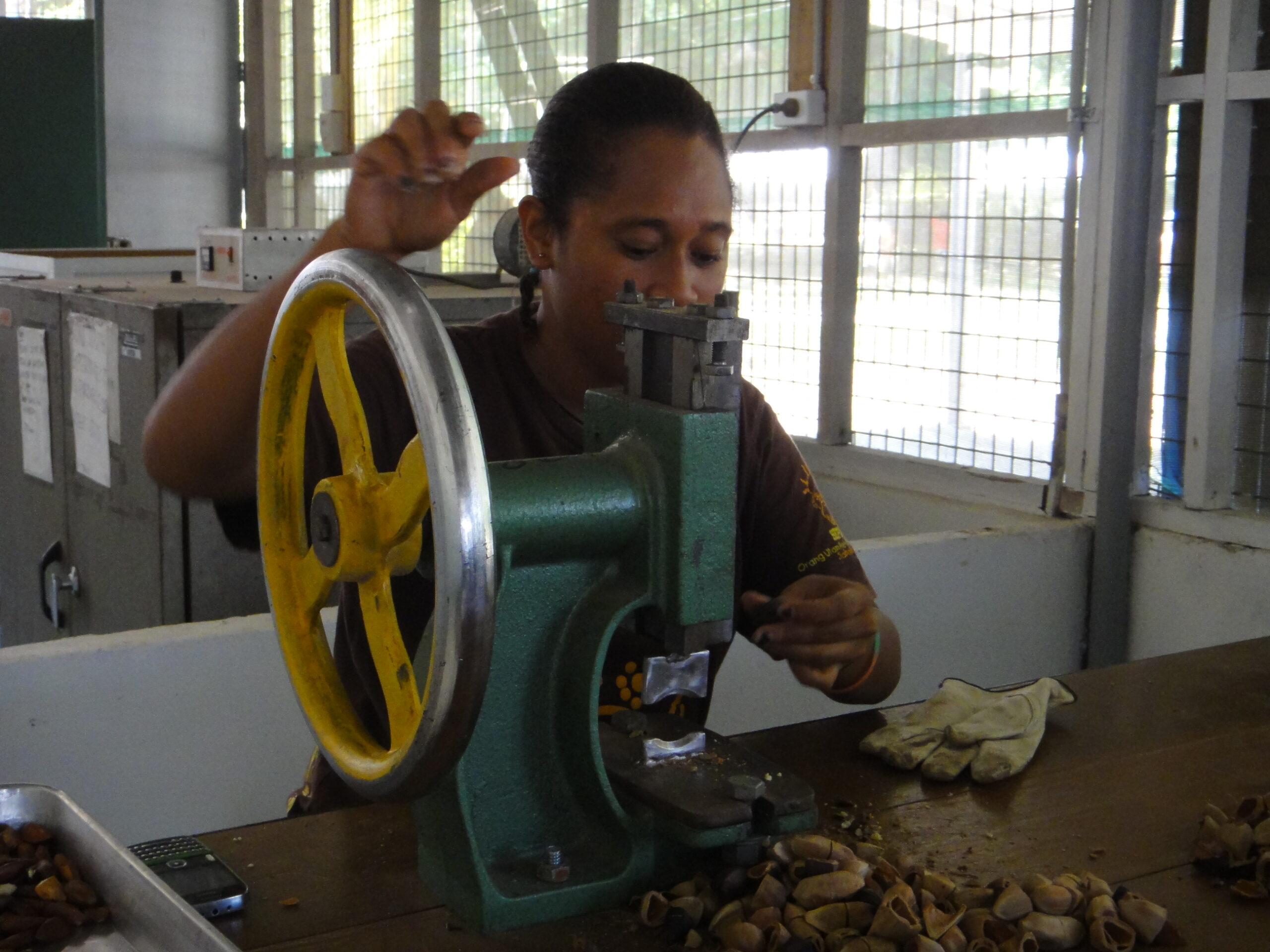
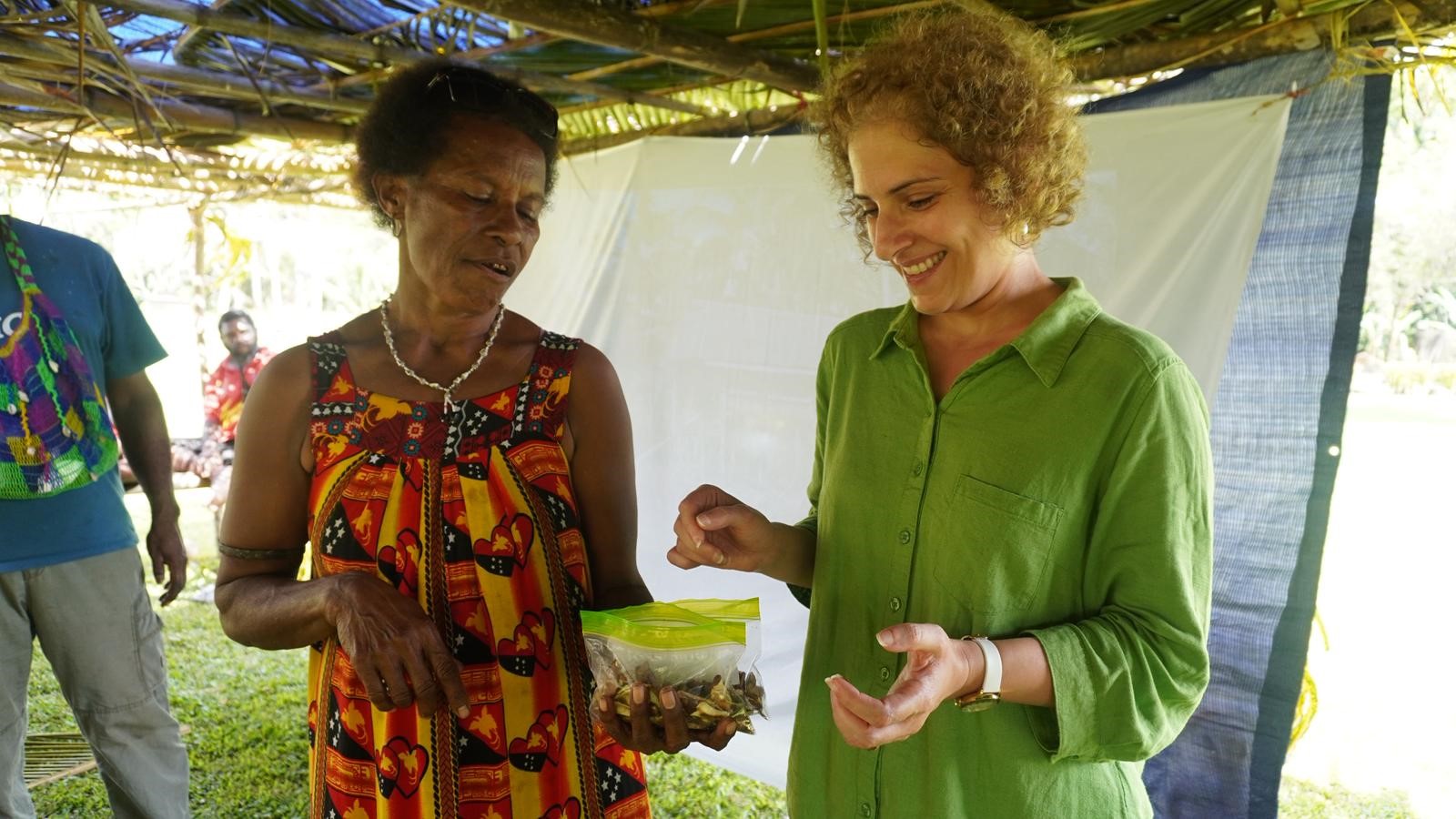
“We developed it as a high-end product,” Hosseini-Bai said. “It’s not a peanut, and we didn’t want to compete with local women selling it fresh in the market and disadvantage them as a result. So the prices are similar to high- end nuts such as almond and macadamia, and it goes to formal markets like the duty-free section or City Pharmacy Limited.”
In okari nuts, Hosseini-Bai sees “a lot of potential, and a lot of things that we can apply” from the experience with galip — including know-how on value adding, safe processing protocols, shelf life stipulations and market approaches. Processing the nuts onsite, by drying or roasting them, could help with transport as it makes them last longer and weigh less, as well as adding value at the village level.
If the approach succeeds, visitors to PNG may one day encounter Managalas not through a logging road or a conservation map, but through taste. More importantly, communities on the Plateau could finally realise a long-held goal: earning reliable income while keeping the forests that sustain them standing.