

As countries, companies and producers prepare for the European Union Deforestation Regulation (EUDR), one thing is already abundantly obvious: technical compliance alone will not deliver truly sustainable outcomes. Without deliberate attention to who gains, who loses and who is left out, new market rules risk reinforcing — or even deepening — existing inequalities across forest and agricultural landscapes.
If you work in sustainability, you are likely familiar with the acronym GESI. You may also be raising a questioning eyebrow — or suppressing an eye roll — at that added “+”. In this case, however, the symbol is not merely decorative. It reflects a growing effort to move beyond gender alone when addressing equity and inclusion in deforestation-free value chains.
GESI+: Gender Equity, Social Inclusion plus Intersectionality
People’s experiences in value chains are shaped not only by gender but also by age, ability, class, ethnicity, indigeneity, religion and other social identities. An intersectional approach examines how these identities interact, creating specific vulnerabilities or opportunities within supply chain governance, due diligence processes and benefit-sharing.
At its core, intersectionality asks a deceptively simple question: which combinations of identity and circumstance shape people’s real access to resources, land, markets, information and decision-making? Gender alone rarely explains exclusion. Age, ethnicity, indigeneity, disability, tenure status, education, language and geography often intersect in ways that determine who can realistically comply with regulations like the EUDR.
To help address this challenge, the Center for International Forestry Research and World Agroforestry (CIFOR-ICRAF) and the GIZ Sustainable Agriculture for Forest Ecosystems (SAFE) project have launched a new Training of Trainers (ToT) facilitation toolkit on Gender Equity, Social Inclusion + Intersectionality for deforestation-free value chains. Designed for practitioners working closest to smallholders, the toolkit aims to support more inclusive, fairer and ultimately more durable transitions to EUDR compliance.
“We were explicitly asked not to repeat existing EUDR trainings, and not to run generic gender workshops,” explains Emily Gallagher, the programme’s principal investigator for CIFOR-ICRAF. “The gap was inclusion, intersectionality and transformation — and how to make that practical for people working directly with producers.”
Everyday roles, relationships and working conditions shape how equity and inclusion are experienced across agricultural value chains. Photo by Axel Fassio / CIFOR-ICRAF
From policy ambition to practice on the ground
SAFE, a flagship project under the Team Europe Initiative on Deforestation-Free Value Chains, supports partner countries in strengthening sustainable, legal and deforestation-free agricultural value chains. Within the programme’s broader portfolio — which includes traceability systems, green finance and producer support — CIFOR-ICRAF was commissioned to focus specifically on gender equity, social inclusion and intersectionality.
The brief was intentionally precise: complement existing technical and policy work, while equipping trainers to navigate the social realities shaping EUDR implementation.
“GIZ country teams are already working with producers, companies, finance actors and traceability partners,” Gallagher notes. “Our role was to strengthen the social side of readiness — particularly for women, Indigenous Peoples and other groups who face higher risks of exclusion.”
The result is a facilitation guide that connects global market regulations with everyday decisions, power dynamics and constraints in forest and agricultural landscapes.
Co-creation across three continents
Rather than designing the toolkit in isolation, the project team adopted a deliberately iterative, co-creation approach from the outset.
An initial design phase — including learning needs assessments, affinity mapping and co-creation workshops with GIZ and partners — shaped the first version of the curriculum. This draft was then tested through a sequence of in-person Training of Trainers workshops:
- Brazil (Altamira, Pará) – April 2025
- Ecuador (El Coca, Orellana) – August 2025
- Indonesia (Palu, Central Sulawesi) – September 2025
Each ToT brought together government technicians, producer organisations, cooperatives, civil society actors and private-sector representatives working in agricultural value chains. After every workshop, the tools were reviewed in detail with country teams.
“We piloted the training, came back, asked what worked and what didn’t, fixed it, and then tested it again in the next country,” Gallagher says. “By the time we reached Indonesia, the toolkit reflected months of real-world feedback.”
This cycle of testing, reflection and revision ensured that the final product remained grounded, adaptable and relevant across very different legal, cultural and institutional contexts.
A final webinar in December 2025 brought the pilot countries together to share their experiences and learn about the final ToT contents at the close of the co-creation cycle.
A villager stands beside a tree in a forest in Ecuador, where land-use decisions are shaped by livelihoods, access to resources and evolving sustainability requirements. Photo by Tomas Munita / CIFOR-ICRAF.
Why intersectionality matters now
As EUDR implementation accelerates, pressure on upstream actors — particularly smallholders — is intensifying. Traceability, legality and due diligence requirements can unlock new opportunities, but only if producers are supported in ways that recognize unequal starting points and differentiated capacities.
By foregrounding facilitation, co-creation and learning-by-doing, the GESI+ toolkit supports fairer and more resilient value chains — where sustainability is understood as social as well as environmental.
What intersectionality looks like in practice
In Indonesia, one of the clearest learning moments came when participants began to realize the limits of their own assumptions about “vulnerable groups”.
“When it comes to women or older farmers, people already have some sense that there’s an issue,” reflects Cecilia Novarina, a gender advisor with GIZ Indonesia. “But beyond that — disability, ethnicity or other identities — the understanding is still quite weak. Some groups are simply not visible in data or discussions at all.”
During exercises such as the ‘power and privilege walk’, participants started questioning why certain producers consistently fell behind in traceability, certification and access to support.
“One sign the training was working was when people began asking, ‘Why is this an issue?’ and ‘Why does this group always face the same barriers?’” Novarina explains. “That kind of questioning didn’t happen before.”
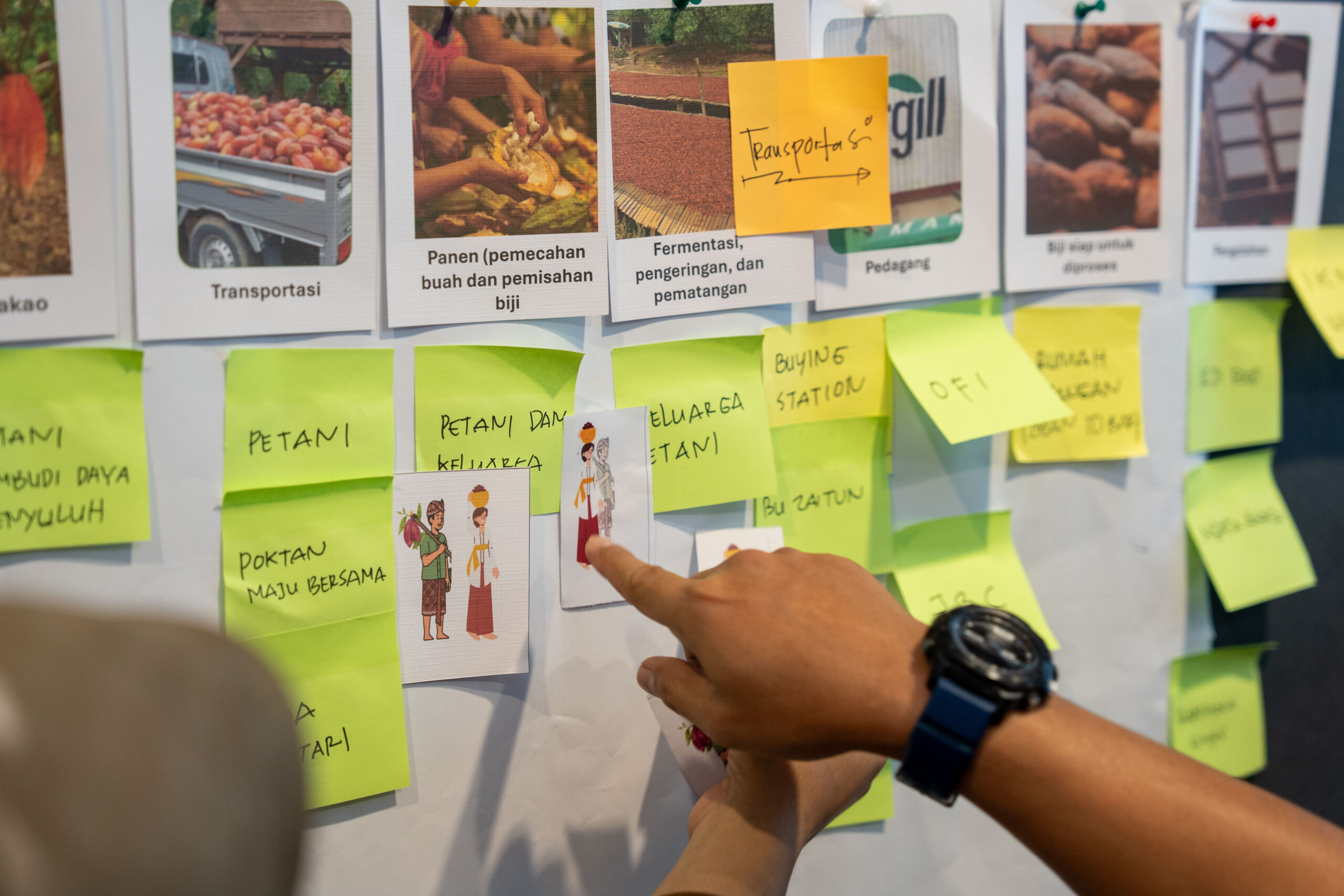
In Ecuador, the ToT highlighted how gender intersects with indigeneity, age and language in Amazonian cocoa and coffee value chains. Participants mapped how Indigenous women often play central roles in nurseries, drying and quality selection, yet remain excluded from traceability systems, producer registries and commercial negotiations.
“When these inequalities overlap — for example, for Indigenous women producers — access to training, certification and governance processes drops sharply,” noted CIFOR-ICRAF’s local facilitator, Elizabeth Vallejo. “Intersectionality helped make those overlaps visible, rather than treating everyone as if they start from the same place.”
These locally grounded discussions shaped how trainers planned to adapt the tools once back in their own organizations.
What the toolkit offers
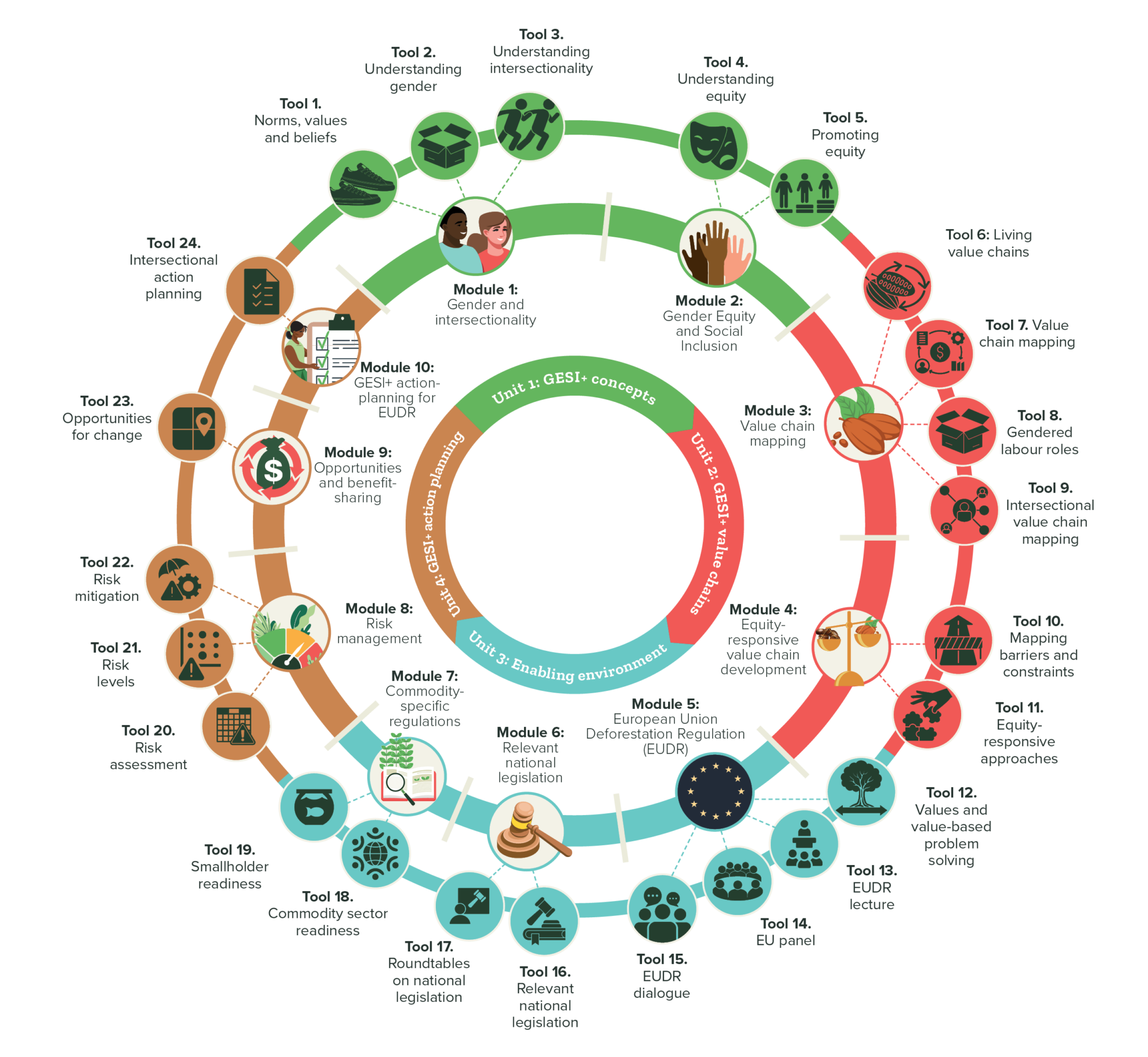
The final ToT Facilitation Toolkit is structured around:
- 10 learning modules, organized into four learning units
- 24 practical facilitation tools, ranging from participatory exercises and value-chain mapping to risk analysis and action planning
- A step-by-step process supporting trainers to develop their own context-specific learning plans
Rather than prescribing a fixed curriculum, the guide encourages trainers to select, adapt and combine tools based on their audience, commodity and institutional setting.
“The goal isn’t to use everything,” Gallagher explains. “Trainers leave with their own learning plan. They integrate what’s useful and leave the rest.”
The toolkit integrates:
- Gender analysis with intersectional perspectives, recognizing how gender intersects with age, ethnicity, tenure status, class, indigeneity and other factors
- Legal literacy on the EUDR alongside relevant national legislation
- Applied methods for identifying risks of exclusion, as well as opportunities for empowerment and fairer benefit-sharing
Explore and download the resources
All materials are now available for practitioners, policymakers and partners:
- Project brief: Gender and Intersectional Equity – Aligning opportunities toward deforestation-free and socially responsible products
- Toolkit: GESI+ for Deforestation-free Value Chains: Training of Trainers Facilitation Toolkit
- Country briefs: Ecuador and Indonesia
- ToT Workshop Video on YouTube
- ToT Webinar on Vimeo: Team Europe Initiative (TEI) Zero Deforestation Learning Series on Gender Equity and Social Inclusion
We invite trainers, programme designers and value chain actors to use, adapt and build on these resources — and to continue the collective work of ensuring that deforestation-free transitions leave no one behind.