
At the Port of Kribi, the horizon is shaped by steel, cargo and the movement of ships. Merchant vessels wait offshore while container cranes pivot above the terminal, part of a steady expansion reshaping this stretch of southern Cameroon‘s coast. It is not the first place one would look for a forest.
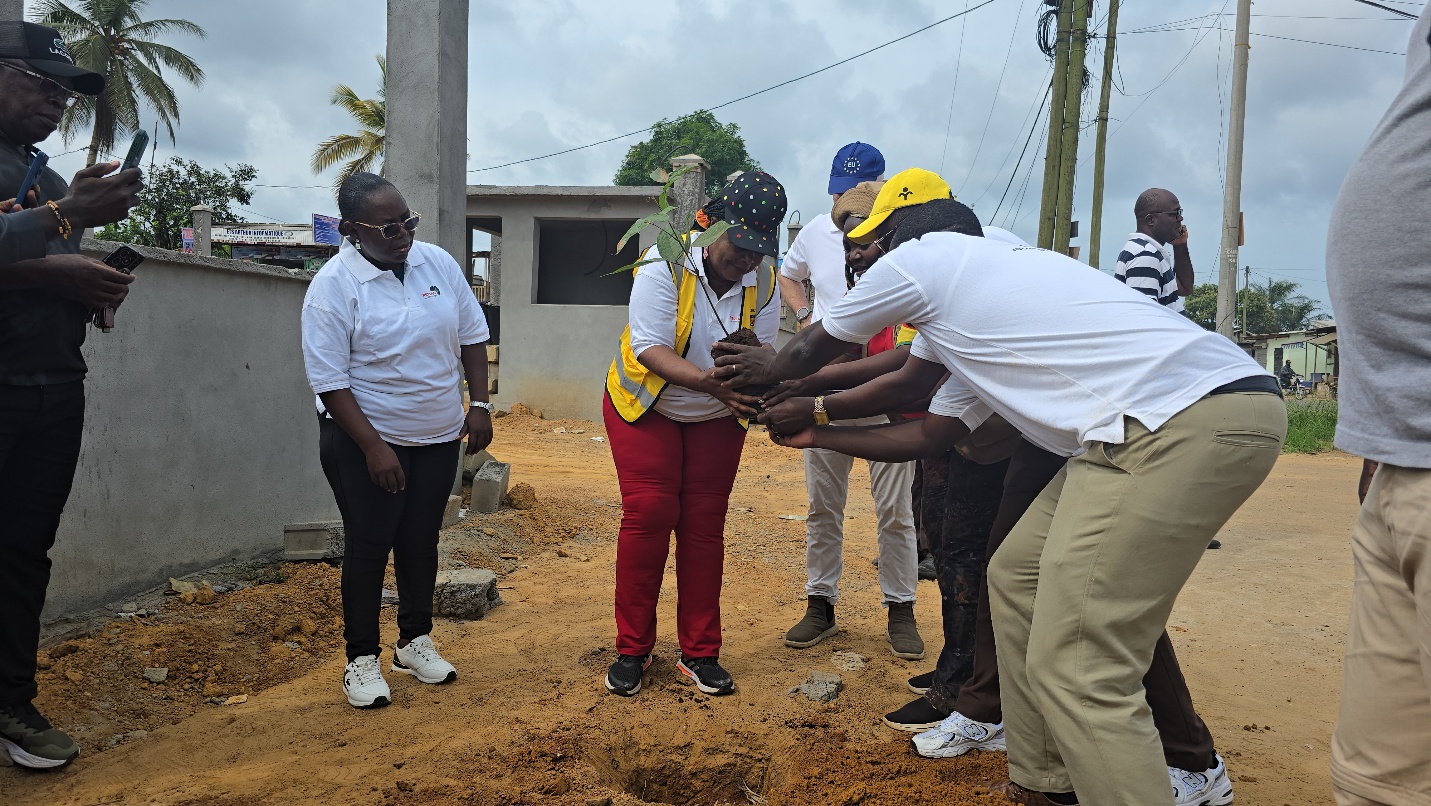
Yet on a humid morning in March 2026, something unusual was happening among the concrete and containers. Public officials, international partners and scientists moved past the logistics lanes and construction crews, then began digging into the earth. They brought forest restoration into a working shipping terminal, planting 500 seedlings in total: half of them bubinga, the rest a mix of forest and agroforestry species.
The choice of venue mattered more than the calendar. The planting, held to mark the International Day of Forests, brought restoration into an industrial port, where development is measured in cargo, infrastructure and trade flows.
The friction of growth
Kribi has become a kind of boomtown on Cameroon’s southern coast, shaped by the same pressures transforming forests across Central Africa: expanding agro-industrial concessions, advancing mining projects and new transport corridors opening into the interior. At the centre of those changes stands the deep-water port, a symbol of economic growth and of mounting pressure on the environment.
Beyond the port’s industrial perimeter, high-value ecosystems flank the industrial zones, including forests that connect directly to Campo Ma’an National Park. The region is also home to Baka and Bagyeli communities whose daily lives and cultures remain closely tied to the forest.
The tree-planting initiative sits inside that tension: how to make room for forest restoration in a place being reshaped by trade, infrastructure and extractive industries.
Trees that will grow with the children
The first trees went into the ground away from the docks, in the courtyards of primary schools across Kribi.
Rows of students stood with young seedlings, carefully copying the planting techniques demonstrated by forestry technicians. For many of the children, it was their first time planting a tree.
“These trees will grow with them,” said one teacher, watching her students press soil around a young seedling. “This activity teaches them patience, but also a sense of responsibility towards trees and the forest.”
The schools have committed to watering, monitoring and caring for the seedlings as part of their educational activities. Environmental clubs have been formed and tracking registers put in place.
Here, reforestation begins with modest acts repeated over time and folded into the school day.
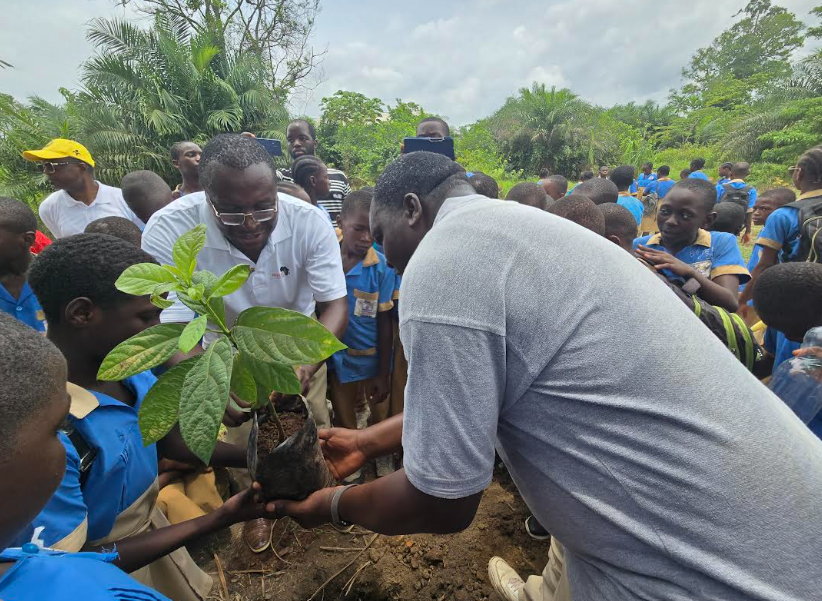
Photo by Merilyne Ojong / CIFOR-ICRAF.
An unexpected green space at the docks
At the port, the setting could hardly have been more different.
The Applied Research in Ecology and Social Sciences in Central Africa (RESSAC) programme planted 500 forest and agroforestry seedlings, including 250 bubinga trees, to begin establishing a woodland within the port itself. In a site dominated by industrial infrastructure, the choice to plant trees there was unusual.
Why bubinga?
Bubinga is a valuable African timber associated with several tree species. Three species commonly traded under the name – Guibourtia demeusei, Guibourtia pellegriniana and Guibourtia tessmannii – are listed in Appendix II of the Convention on International Trade in Endangered Species of Wild Fauna and Flora (CITES). International trade in the three species is regulated under the convention.
Planting 250 bubinga seedlings inside the port gives the restoration effort a longer horizon. The trees have been placed in the same industrial space where Kribi’s growth is unfolding.
“What makes this initiative so strong is that it shows environmental responsibility does not always have to come after development,” said Stephen Peedel of the European Union Delegation to Cameroon. “It can be integrated from the beginning, as development activities are being implemented.”
Young trees now stand among cranes and containers. Still fragile, they place forest restoration inside the port’s boundaries and alongside the infrastructure driving Kribi’s growth.
Looking beyond the planting
The day’s work did not end with the trees.
Researchers, public authorities, businesses, civil society organizations and community representatives gathered for a panel discussion on the rapid changes affecting forests in southern Cameroon.
Remote sensing, spatial analysis and field surveys are helping scientists track those changes. The discussion also turned to the experiences of the people living through them.
“Landscapes are changing very quickly, but beyond the data, it is essential to understand what those changes mean for people, particularly those who depend directly on forests,” said Richard Sufo, senior scientist and coordinator of the RESSAC programme.
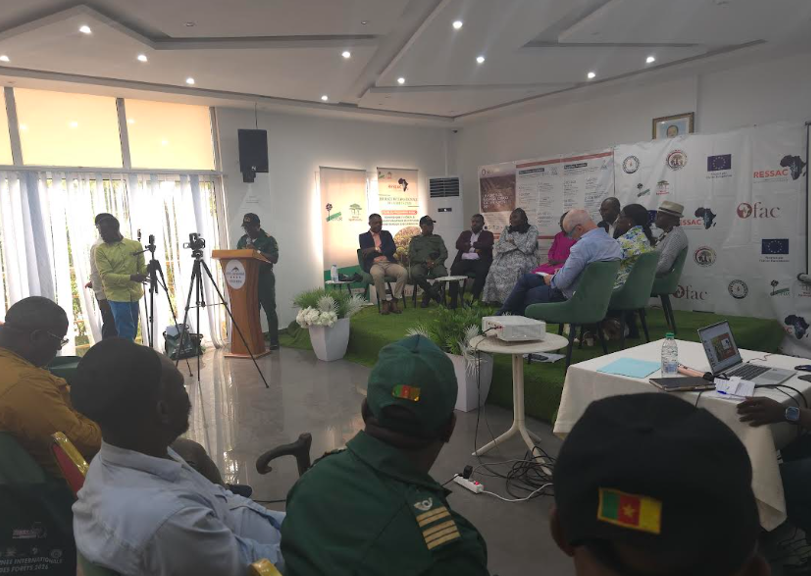
Photo by Merilyne Ojong / CIFOR-ICRAF.
That combination of scientific evidence and lived experience is central to RESSAC, implemented by the Center for International Forestry Research and World Agroforestry (CIFOR-ICRAF), with financial support from the European Union.
The programme produces scientific data, strengthens local capacity and brings researchers, decision makers, the private sector and communities into the same discussions. In rapidly changing places such as Kribi, the aim is to give those making planning decisions a clearer picture of what is happening to forests and what those changes mean for the people who depend on them.
The seedlings, however, are only the beginning. Their survival will depend on what comes next.
In Kribi, equipment is due to be distributed to help care for the young trees. Commemorative plaques are planned at the port and agreements are expected to formalize the monitoring of the work already underway.
RESSAC also plans to continue providing technical support to local authorities, municipalities, businesses and communities, helping them care for the trees and build their capacity over the longer term.
The programme is also working alongside other initiatives, including the Central African Forest Observatory – Centre of Excellence (OFAC-CE). Research findings and data produced through RESSAC are expected to be made available on OFAC’s digital platform.
That evidence could help guide future decisions about the management of the port’s new woodland as Kribi’s industrial and economic expansion continues.