

The Provision of Adequate Tree Seed Portfolios (PATSPO) project has so far established 62 breeding orchards (BSOs) and seedling seed orchards (SSOs) since 2018. The project was launched in May 2017. The third phase of the project, PATSPO III, has started on 1st April 2026.
But BSOs and SSOs cannot simply be planted and left alone; they need to be managed. If trees in seed orchards are left to grow indefinitely, they begin to compete for light, water and nutrients. Selective thinning, in which trees with undesired genetic properties are removed, is therefore a major activity in the management of BSOs. Without thinning, BSOs cannot effectively realize their major objective: producing high-quality seed.
Growth measurements are central in deciding which trees to thin. In collaboration with researchers from the Ethiopian Forestry Development (EFD), PATSPO has been measuring the BSOs established in different regions of Ethiopia. Based on those measurements, six BSOs have so far been thinned, three of them twice.
How many times should a seed orchard be thinned?
Dr Abrham Abiyu, a researcher at the Center for International Forestry Research and World Agroforestry (CIFOR-ICRAF) headquarters in Nairobi and a former PATSPO staff member, explained that thinning schedules depend on the species and the orchard design.
“Based on the PATSPO BSO establishment report and registration protocol, for instance, the first three growth measurements of Grevillea robusta BSOs are carried out two, five and nine years after their establishment,” he said.
A BSO or SSO can be thinned two to three times, depending on the initial planting distance and tree density. In some orchards, especially those with fast-growing species, competition begins early. Their canopies close quickly, and the trees become too tall and too slender. In such cases, orchards may need thinning more than three times.
Søren Moestrup, senior team leader of PATSPO, says, “It is not about how many times we can, but how many times we need to do the thinning.”
Seed can be collected from a seed orchard after the first thinning. A seed orchard doesn’t have to be thinned two or three times before seed collection begins.
“As long as trees in the orchard give seed, we can, in principle, collect the seed from them,” said Moestrup. “But it may not be financially feasible, and the number of trees participating in pollination is low when only a few trees are flowering. We may need to wait until 50 percent of them are flowering for the seed collection to be financially feasible and genetically suitable.
The difference between BSO and SSO thinning
In February 2026, two EFD researchers, Dr Eguale Tadesse and Kebede Gizachew, were at the Faidherbia albida BSO in Mojo, Oromia, established by PATSPO in 2019 in partnership with Oromia Forest and Wildlife Enterprise (OFWE). Together with three workers, they were thinning the orchards by identifying which trees to keep and which to remove, based on measurement and genetic analysis. The trees selected for removal were marked with red ink on their stems.
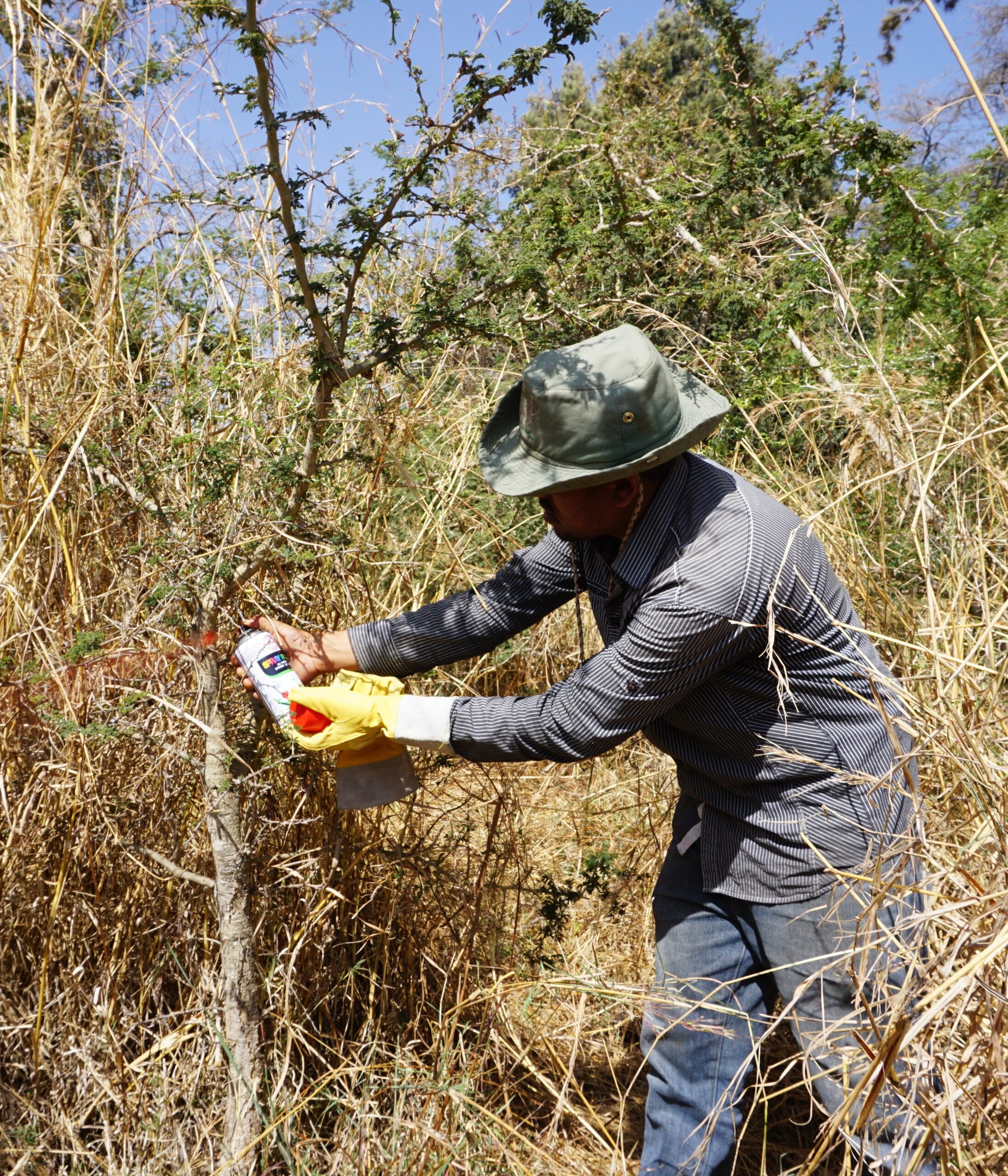
Photo by Eyob Getahun / CIFOR-ICRAF
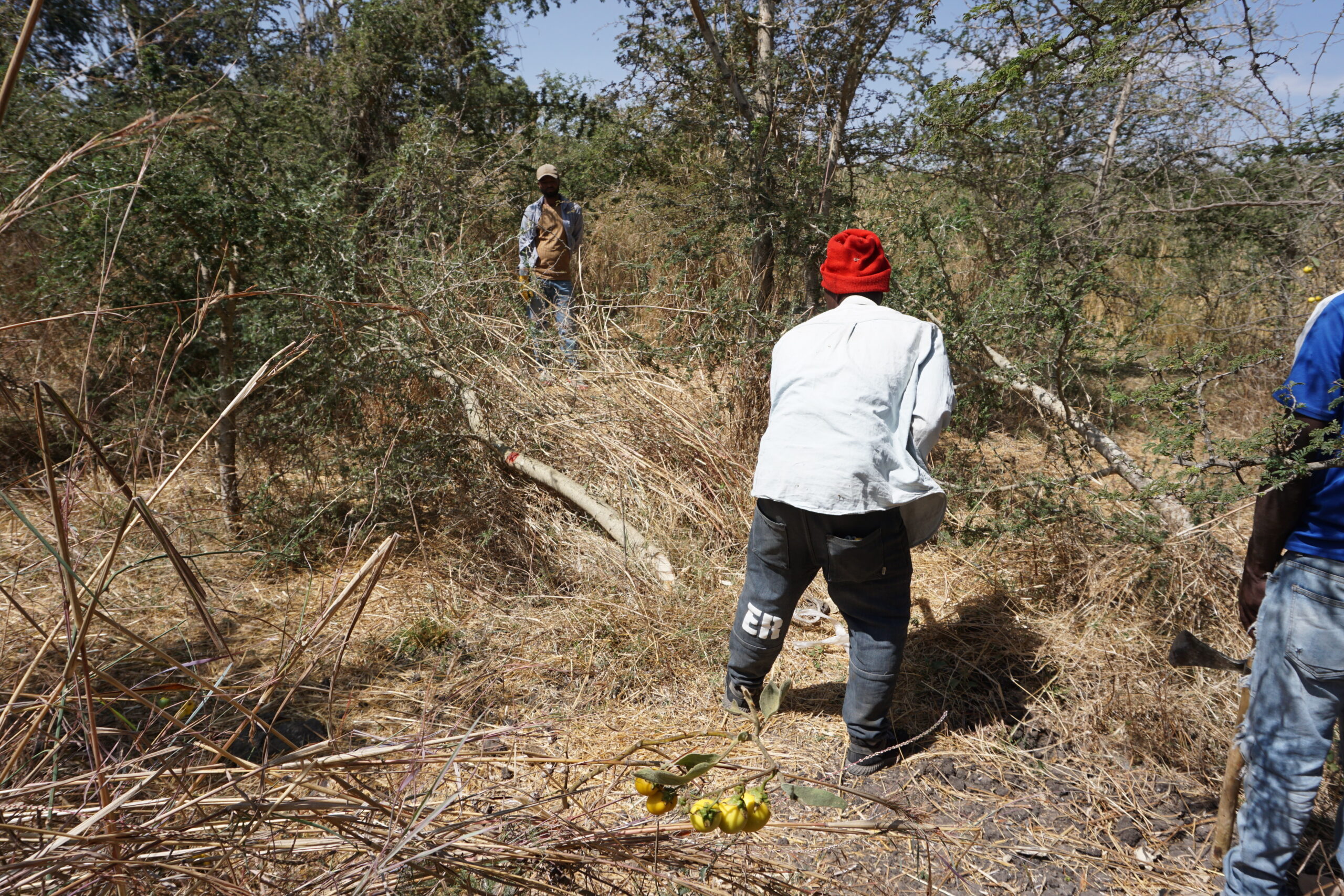
Photo by Eyob Getahun / CIFOR-ICRAF
One of the trees marked to be thinned out appeared healthier and better than most in the seed orchard. When asked why such a tree was to be removed, Eguale said the answer lay in the difference between appearance and breeding value.
“Particularly in BSOs, the two most important criteria to decide which trees to thin out are growth and provenance (family),” he said. “We are supported by the University of Copenhagen (UCPH) with genetic analysis. The genetic analysis includes the diversity of the breeding seed orchard.”
Carsten Norgaard, a consultant from UCPH, said visual appeal alone cannot guide thinning decisions.
“We are considering the family and genetic diversity regardless of the beauty of the tree,” he said. “We must work according to the genetic analysis. Keep is keep, remove is remove. We should never be tempted to leave a beautiful tree that needs to be removed. A family could dominate if we only consider the phenotypic characteristics of trees in BSOs.”
That is what distinguishes BSO thinning from SSO thinning. Genetic analysis is done only for BSOs, not SSOs. BSOs are not only seed sources; they are also used for breeding and to maintain genetic diversity.SSOs, by contrast, are established primarily as seed sources.
In the BSOs, seeds collected from superior trees are kept separate. Seedlings from each family, or provenance, are raised separately in a nursery, then planted in the field following an incomplete and randomized block design according to their family identities. That means researchers know which family each tree belongs to.
Before thinning a BSO, three measurements are conducted.
“The height and the diameter at breast height (DBH) are measured, and other tree characteristics like crooking, branching and the presence of disease are carefully observed and noted,” said Dr Wubalem Tadesse, research project coordinator for PATSPO III.
Genetic analysis is carried out based on the measurement of DBH, height and family identity. That data is used to decide which trees to keep and which to remove.
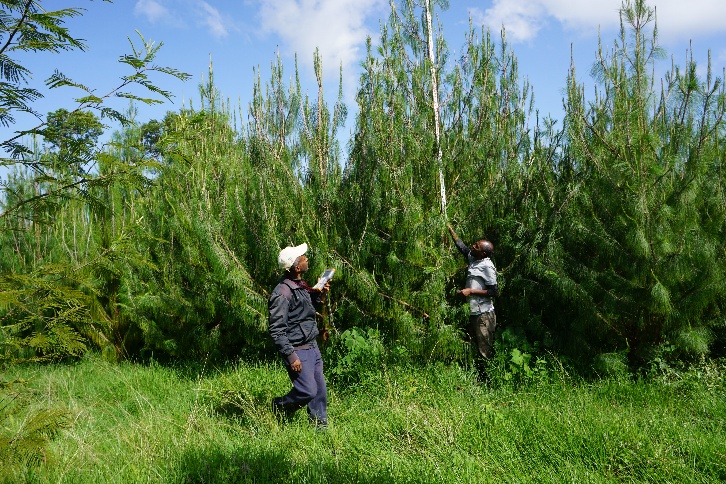
Photo by Carsten Norgaard / UCPH
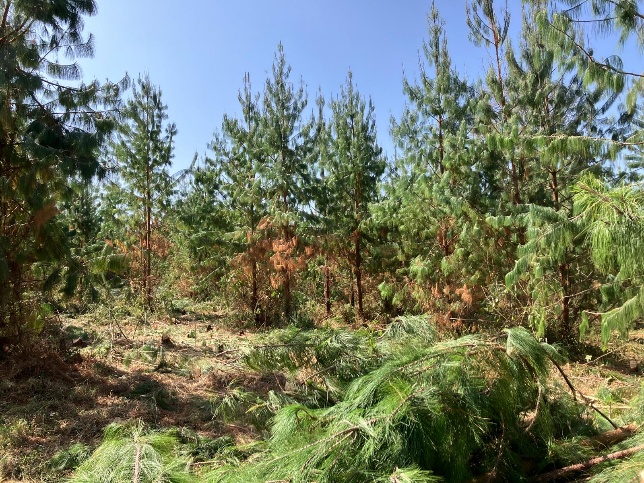
Another important parameter to consider while thinning a BSO, Wubalem noted, is genetic diversity. Even when a family’s performance is not as good as some others, some of its trees may still be retained to preserve diversity. And some trees from better-performing families may still be removed. In other words, thinning a BSO is guided not only by the tree measurement results, but also by the family identity. That is why some good-looking trees in the Faidherbia albida BSO still had to be removed.
If some families continue to perform poorly, they may be removed entirely in later rounds of thinning.
“Although thinning BSOs reduces the genetic variation of the species in question, we do it to ensure optimal growth of the trees in the BSOS and only to keep the best trees producing the highest-quality seed,” said Moestrup. “The overall aim of having a BSO is not to conserve genetic variation; it is to produce quality seed.
In the end, only a few hundred trees per hectare remain to serve as seed sources.
In SSOs, the process is different. Seed from superior trees is mixed in equal amounts by weight before sowing, so seedlings are planted without family identity. Thinning is therefore based on measurements, visible assessment and characteristics of the best-performing trees.
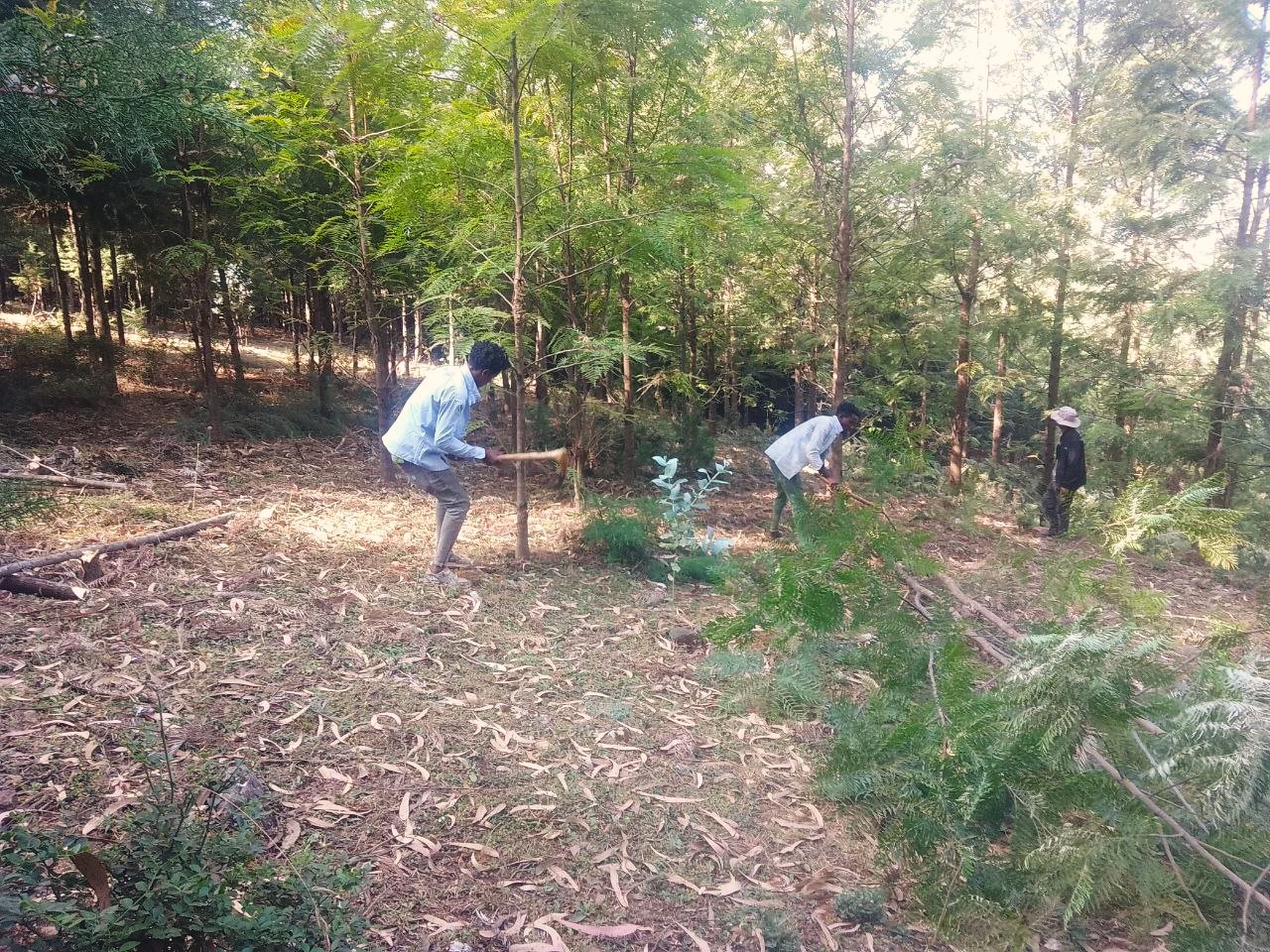
Thinning of SSOs is thus simpler because it doesn’t take genetic diversity into consideration.
“All parameters measured before thinning a BSO are also measured for SSO,” said Wubalem. “Based on the data from the measurement, we first thin out the defective and low-performing trees. If the number of defective trees is fewer than the number of trees we have already decided to remove, we use phenotypic (observable) characteristics to keep and remove trees but always seriously considering the density of the trees in the orchard.”
This thinning process is called phenotypic thinning.
EFD will take over the responsibility for thinning seed orchards
To carry out the thinning of BSOs, PATSPO has so far worked closely with EFD. The four people who measure BSOs and SSOs, in two teams, are all researchers and have received training organized by PATSPO.
When PATSPO III ends in late 2029, EFD staff are expected to take over responsibility for helping orchards — mainly Amhara Forest Enterprise (AFE) and Oromia Forest and Wildlife Enterprise (OFWE) — with measurements, analysis and preparation of thinning plans. But now, the genetic analysis of the BSOs is still carried out by the UCPH.
“This will change during PATSPO III”, said Moestrup. “We will have people coming from UCPH to give training courses on how to do the genetic analysis. The whole strategy of PATSPO I, II and III is to train our partners and build their capacity. Anything we do, we do with partners, and we have to continuously strengthen their capacity.”
Thinning seed orchards in insecure areas
Security problems in parts of Ethiopia are also affecting orchard management. The project has established 18 seed orchards in the Amhara Region, where insecurities have persisted for the past two and a half years. Some AFE field staff can still access the BSOs and SSOs there, but the situation has made it impossible to send EFD staff to measure and thin them. That matters because some of the fast-growing species established six years ago are now due for thinning. One example is the Eucalyptus grandis BSO at Yeraba, near Debre Markos, which PATSPO II has already identified as too dense. If it is not thinned soon, the trees will become too tall, making seed collection much harder as the seed moves higher into the crown.
“We don’t do any measurement. We don’t do any genetic analysis; we just do a simple systematic thinning,” said Moestrup. “We have decided to remove every second tree so that we have better spacing. That is a compromise. This is not the ideal way to do it, but it is better than leaving the BSO unthinned. We don’t know when we will get access to the BSO, so we decided to do the systematic thinning with the AFE staff there.”
PATSPO II knows the BSOs thinned this way will not be as good as they could be under normal conditions, but they will still be better than other seed sources in the country that were not established as seed orchards.
“This is an emergency situation and not something we want to do,” Moestrup added, “but we have to do it.”
PATSPO III, the third phase of the successful tree seed project in Ethiopia, will launch soon. Over the next four years, project staff and consultants will continue rolling up their sleeves, measuring and thinning BSOs together with EFD and other partners.